Build a compact route, observe a repeatable cash loop, and change one variable at a time before you expand.
Money farmCompact routeRepeatable test
Current money-farm answer
Build the smallest route that lets visitors repeat the cash loop
A useful money farm in Build Your Backrooms is not a secret code or a guaranteed layout. It is a compact route where visitor movement and the cash loop are easy to observe, compare, and retest after a change.
Official Roblox thumbnail used for game context; the route advice is editorial guidance, not measured earnings proof.
Money-farm test
Build Your Backrooms money farm in 5 controlled steps
Treat money farming as a repeatable route test. First make visitor movement visible, then compare the cash loop before and after one deliberate change. This keeps a slow run diagnosable instead of turning every new room into a guess.
Step
What to do
What a useful result looks like
1. Build a short route
Connect the entrance to one readable loop before adding extra branches.
Visitors have a visible path and you can see where the loop stalls.
2. Watch visitor traffic
Run the route without changing several rooms at once and note the repeated lane.
You know which corridor, turn, or entrance actually carries traffic.
3. Make one money change
Move one placement or connection beside proven traffic, then leave the rest stable.
The next run can be compared with the previous route.
4. Compare more than one loop
Check repeated passes and the cash progression instead of trusting one lucky reward.
The result has a pattern that another retest can challenge.
5. Expand one branch
Add one branch only after the compact loop is understandable and record what changed.
You can tell whether the new space helped or diluted traffic.
Official Roblox thumbnail used for game context; the route advice is editorial guidance, not measured earnings proof.Route-choice matrix
Where a Build Your Backrooms money farm is easiest to test
Route area
Use it when
Avoid it when
Main loop
You need a clear baseline for visitor movement and cash progression.
The loop is already so wide that traffic cannot be followed.
Entrance
You are checking whether visitors enter and continue into the farm route.
Decorations or branches hide the first movement checkpoint.
Turn or choke point
Visitors naturally gather there and the path remains readable.
The point has not been used by visitors in a repeatable run.
Side branch
The compact loop is stable and you can compare the branch separately.
You are adding space to solve a problem you have not observed.
After an update
Rooms, UI, visitor movement, monsters, or economy behavior visibly changed.
You are treating an old route claim as a current guarantee.
Money-farm test
What money farming means on this site
This page uses money farm to mean a repeatable route for observing visitor movement and cash progression in Build Your Backrooms. It does not claim a universal income rate, an offline payout, a hidden multiplier, or a guaranteed best layout. The Similarweb phrase-match signal points toward beginner money-farm questions, but it does not supply verified in-game values. That is why the useful target here is the decision process: make a compact loop, isolate a change, compare repeated passes, and keep unverified numbers out of the guide. If the game changes, the route must be tested again rather than copied as a permanent recipe.
Money-farm test
Build the baseline before chasing speed
Start with the smallest route that lets you see visitors enter, move through a corridor, reach a turn, and complete the intended loop. A large maze can feel productive while hiding the reason a run is slow: an unused entrance, a split path, or a connection that visitors do not follow. Keep the first version easy to describe in one sentence. Once the baseline repeats, record the route shape and make one deliberate money-related change. This is slower than placing everything at once, but it gives you a useful comparison and makes the next update easier to audit.
Money-farm test
Use traffic as the signal, not decoration
A money farm is only informative when visitors actually use it. Watch the same checkpoints across more than one pass: entrance, main lane, turn, and the point where cash progression should become visible. If visitors stop before the intended loop, inspect the route before moving a monster or adding another room. If traffic splits, simplify the branch so one result has fewer explanations. The guide can help you choose what to observe, but it cannot replace a current player check. Treat a copied layout as a hypothesis until the current game state produces a recognizable pattern.
Money-farm test
Compare runs without inventing numbers
Write down what changed and what you could actually observe: whether visitors entered, which lane they used, whether the loop repeated, and whether the next progression step appeared. Avoid turning one lucky reward into a precise per-minute claim. Compare the same route under similar conditions whenever possible, and do not change the entrance, branch, monster placement, and decoration at the same time. A simple before-and-after note is more useful than a confident number with no method. When a result is inconsistent, label it as a retest needed rather than presenting it as the best money farm.
Money-farm test
Expand only after the loop is explainable
Expansion should answer a new question, not cover up an old one. Add one branch, move one placement, or change one connection, then revisit the same traffic checkpoints. If the new space makes the route harder to follow, return to the compact baseline and remove the extra variable. A farm that is easy to inspect is more valuable than a wide build that cannot show why income slowed. When a visible Roblox update changes rooms, UI, visitor movement, monsters, or economy behavior, repeat the baseline test before publishing a refreshed recommendation.
Money-farm test
What this guide does not promise
This page does not publish an exact cash rate, a secret code, a guaranteed monster payout, or a claim that one layout works for every player. Those facts require a current, repeatable check from the game and may change with updates. Use the existing beginner guide for the first route, the wiki for fields that need evidence, and the official Roblox experience for the current game surface. The practical value of this page is a controlled method for finding and explaining your own money loop without confusing a single observation with a permanent rule.
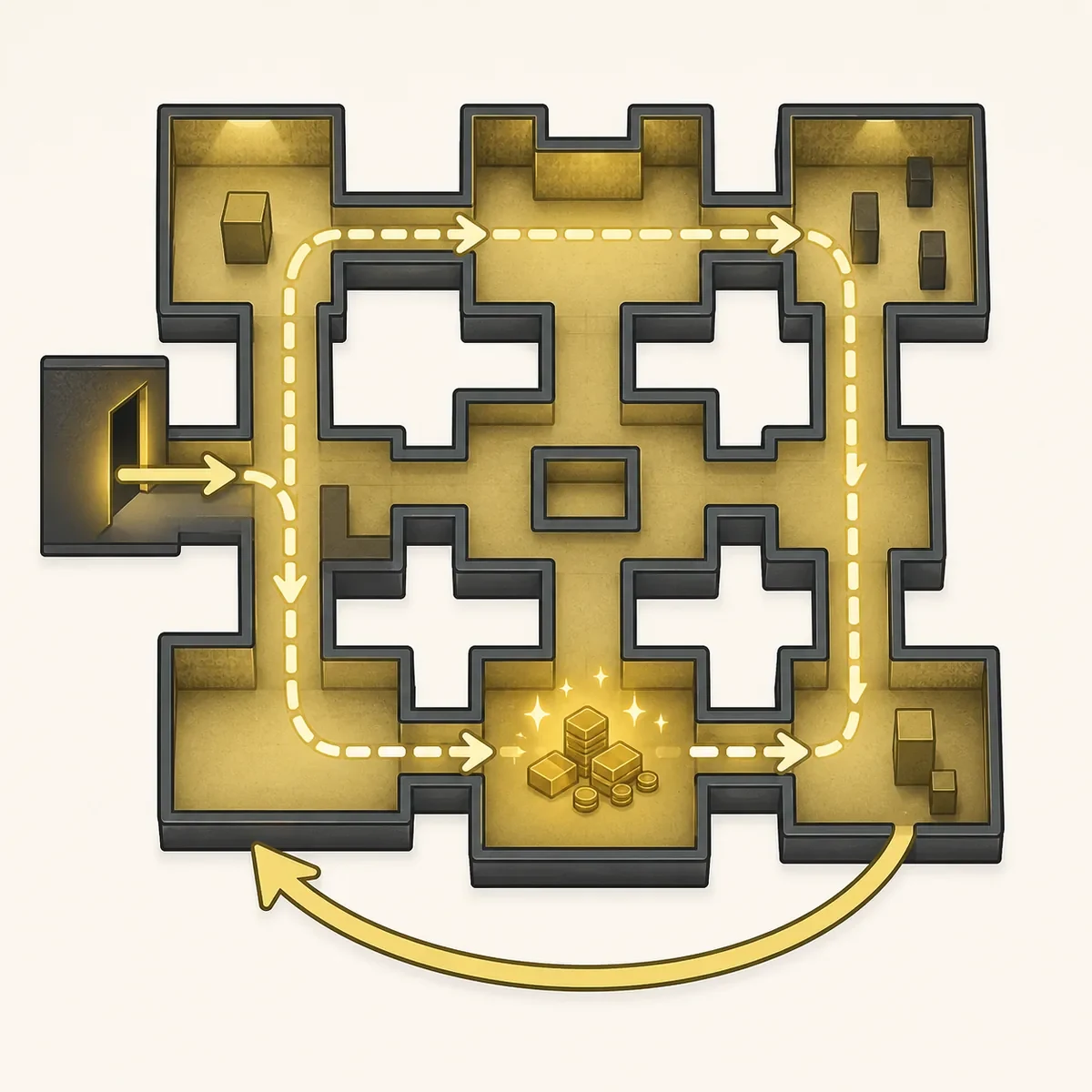
Editorial illustration
A compact cash loop is easier to inspect
Illustration only: use a visible route and repeatable checkpoints to test a money loop; it is not an official gameplay screenshot.
There is no verified universal best layout in this guide. Start with one compact visitor loop, observe repeated traffic, and compare one change at a time.
How do I make a money farm as a beginner?
Build a short route from the entrance, watch where visitors actually move, then test one connection or placement beside that traffic before expanding.
Does this page give an exact cash-per-minute rate?
No. Exact rates remain unverified unless a current, repeatable in-game check supports the conditions and method.
Should I add more rooms when the cash loop is slow?
Not immediately. First check the entrance, main lane, turn, and repeated visitor passes. Add one branch only after you can explain the compact route.
When should I retest a money farm?
Retest after a visible change to rooms, UI, visitor movement, monsters, economy behavior, or other Roblox metadata that could affect the route.